3D Analytics vs Traditional Analytics: A Complete Comparison
See how modern 3D visualization transforms data understanding compared to traditional charts and graphs. A comprehensive guide to the future of analytics.

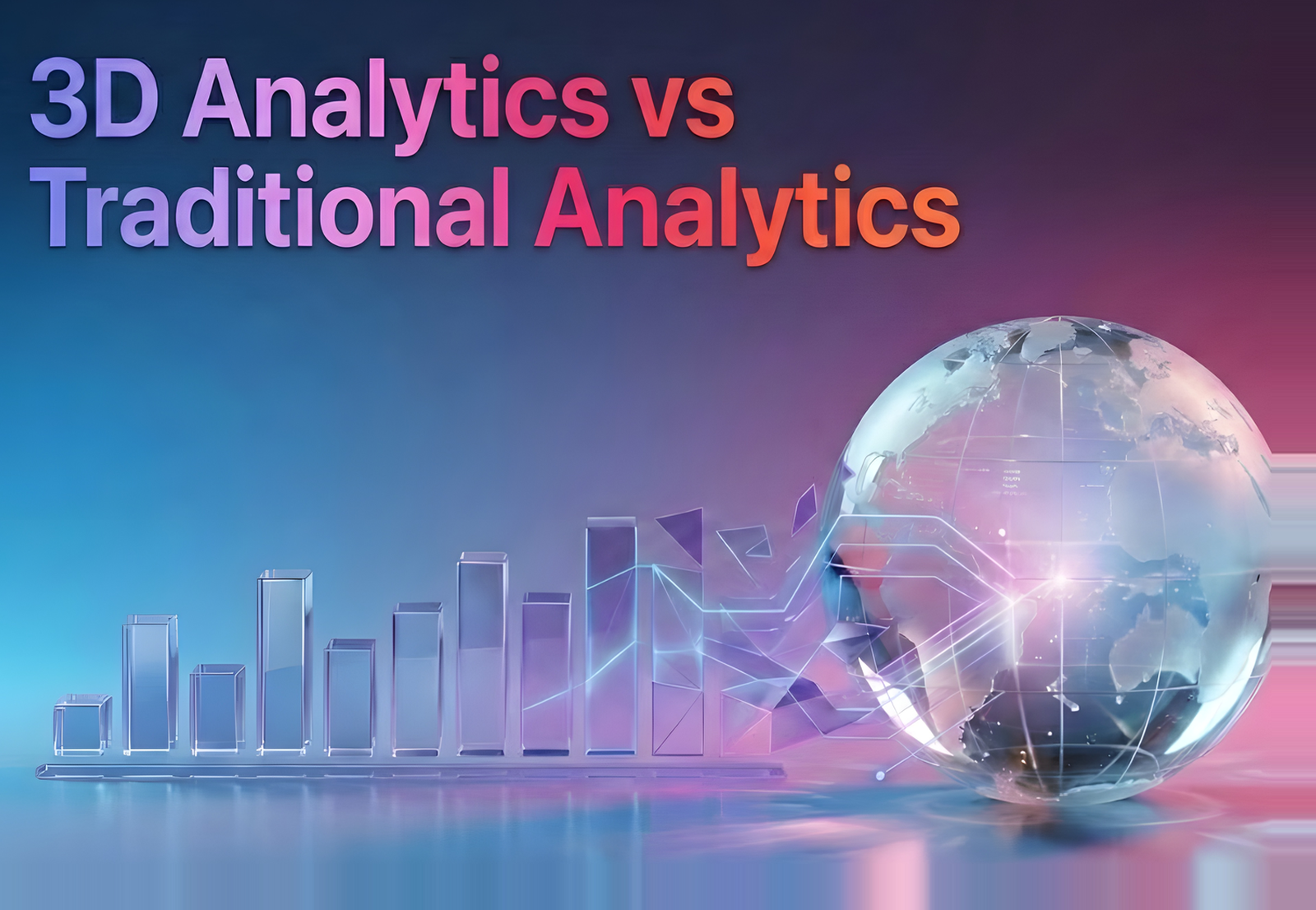
The way we visualize and interpret data is undergoing a revolutionary transformation. While traditional analytics have served businesses well for decades, 3D analytics represent a paradigm shift that's changing how we understand user behavior, geographic patterns, and temporal trends.
The Traditional Analytics Landscape
Traditional analytics platforms have built their reputation on familiar visualization methods:
- Bar charts and line graphs: Perfect for showing trends over time
- Pie charts: Ideal for displaying proportional relationships
- Tables and spreadsheets: Comprehensive data display with sorting capabilities
- Heat maps: Two-dimensional intensity visualizations
- Funnel charts: Sequential process visualization
These tools have proven their worth across countless business scenarios. They're familiar, widely understood, and excellent for detailed analysis. However, they often require significant mental processing to translate 2D representations into actionable insights.
Enter 3D Analytics
3D analytics leverage three-dimensional visualization to create immersive, intuitive data experiences. Instead of requiring users to interpret abstract charts, 3D analytics present information in formats that mirror how we naturally perceive the world.
Key Characteristics of 3D Analytics
- Spatial relationships: Data positioned in three-dimensional space to show geographic, hierarchical, or temporal relationships
- Interactive exploration: Users can rotate, zoom, and navigate through data landscapes
- Multi-dimensional encoding: Color, size, position, and movement all convey different data dimensions simultaneously
- Real-time animation: Temporal changes shown through smooth animations rather than static comparisons
Side-by-Side Comparison
Geographic Analysis
Traditional Analytics:
United States 4,523 6,891 $12,450
United Kingdom 3,102 4,567 $8,230
Germany 2,201 3,344 $5,670
3D Analytics:
- Interactive globe showing visitor density as glowing points
- Color-coded markers indicating high-value (gold), medium-value (blue), and standard (gray) visitors
- Real-time animations showing new visitors appearing
- Immediate visual understanding of global reach and value distribution
Real-Time Monitoring
Traditional Analytics:
- Separate "Real-Time" dashboard with numbers and basic charts
- Active users counter
- Top pages list
- Traffic source breakdown
- Geographic distribution map (often static)
3D Analytics:
- Live 3D globe with animated visitor arrivals
- Floating statistics panels that update in real-time
- Visual trails showing user journey paths
- Pulsing indicators for high-engagement sessions
- Integrated view combining geography, time, and behavior
Advantages of 3D Analytics
1. Intuitive Understanding
Our brains are naturally wired to process three-dimensional information. When you see a 3D globe with glowing points representing visitors, you immediately understand global reach without needing to interpret country names or coordinates.
2. Multi-Dimensional Data Display
Traditional charts typically show 2-3 data dimensions effectively. 3D analytics can simultaneously display:
- Position: Geographic location or categorical grouping
- Color: Value, conversion rate, or engagement level
- Size: Volume, revenue, or importance
- Movement: Trends, flows, or changes over time
- Intensity: Activity level or concentration
3. Pattern Recognition
Patterns that might be hidden in traditional tabular data become immediately apparent in 3D visualizations. Seasonal trends, geographic clusters, and behavioral correlations emerge naturally through spatial and temporal representation.
4. Engagement and Retention
Interactive 3D analytics create an engaging experience that encourages exploration. Users spend more time analyzing data and are more likely to discover actionable insights.
When Traditional Analytics Still Excel
While 3D analytics offer compelling advantages, traditional approaches remain superior in certain scenarios:
Precise Numerical Analysis
When you need exact values, precise comparisons, or detailed calculations, traditional tables and charts provide the necessary granularity and accuracy.
Historical Trend Analysis
Line charts remain unmatched for showing detailed trends over extended time periods, especially when comparing multiple metrics simultaneously.
Regulatory Reporting
Compliance and audit requirements often mandate specific chart types and data presentations that traditional analytics handle more effectively.
The Hybrid Approach: Best of Both Worlds
The most effective analytics platforms don't force users to choose between 3D and traditional visualizations. Instead, they offer a hybrid approach that leverages each method's strengths:
- 3D overview: Start with immersive 3D visualizations for pattern recognition and exploration
- Traditional drill-down: Click through to detailed traditional charts for precise analysis
- Contextual switching: Automatically present the most appropriate visualization type for each data query
- Integrated dashboards: Combine 3D and 2D elements in unified interfaces
Technical Considerations
Performance Requirements
3D analytics require more computational resources than traditional charts. However, modern web technologies and optimized rendering engines have made 3D analytics accessible on standard business hardware.
Learning Curve
While 3D analytics are often more intuitive for pattern recognition, users may need training to fully leverage interactive features and interpret complex multi-dimensional displays.
Data Processing
Effective 3D analytics require careful data preprocessing to ensure optimal visual representation and smooth real-time performance.
Industry Applications
E-commerce
3D analytics excel at showing customer journey flows, geographic sales patterns, and real-time shopping behavior. Traditional analytics remain essential for precise conversion funnel analysis and detailed financial reporting.
SaaS Platforms
User engagement patterns, feature adoption flows, and geographic usage distribution benefit from 3D visualization, while churn analysis and subscription metrics often require traditional detailed charting.
Content Publishing
Content consumption patterns, audience engagement flows, and viral sharing networks are naturally suited to 3D representation, complemented by traditional analytics for detailed performance metrics.
The Future of Analytics Visualization
The future of analytics lies not in replacing traditional methods entirely, but in creating intelligent systems that automatically choose the most effective visualization method for each specific question or dataset.
Emerging Trends
- AI-driven visualization selection: Systems that automatically choose optimal display methods
- Mixed reality integration: Combining 2D and 3D elements in immersive environments
- Voice-activated exploration: Natural language queries generating appropriate visualizations
- Collaborative 3D spaces: Shared virtual analytics environments for team exploration
Making the Choice
When evaluating 3D versus traditional analytics, consider these factors:
- User goals: Exploration and pattern discovery vs. precise measurement
- Data complexity: Multi-dimensional relationships vs. specific metrics
- Audience sophistication: Technical analysts vs. business stakeholders
- Decision speed requirements: Quick insights vs. detailed analysis
- Data volume: Large, complex datasets vs. focused metric sets
Conclusion
3D analytics represent an evolution in how we understand data, not a replacement for traditional methods. The most successful organizations will be those that recognize when each approach is most effective and integrate both seamlessly into their decision-making processes.
As data volumes continue to grow and business decisions become increasingly complex, the ability to quickly identify patterns and relationships becomes more valuable than ever. 3D analytics provide this capability while traditional analytics continue to excel at precision and detailed analysis.
The future belongs to platforms that offer the best of both worlds—immersive 3D exploration for discovery and insight generation, backed by traditional analytical rigor for validation and precise measurement.
Michael Johnson
Senior Data Analyst at Zenovay
Michael has spent over 10 years working with analytics platforms, from traditional business intelligence tools to cutting-edge 3D visualization systems. He specializes in helping organizations choose the right analytical approach for their specific needs and has implemented analytics solutions for Fortune 500 companies across multiple industries.