[ Analytics ]
Building and Analyzing Conversion Funnels with Zenovay
Learn how to build, track, and optimize conversion funnels to maximize your website performance. A practical guide to funnel analysis, drop-off detection, and conversion optimization.
On this page
Understanding how visitors move through your website is essential for growth. Conversion funnels provide a structured way to visualize user journeys, identify where people drop off, and optimize each step to improve your overall conversion rate. In this guide, we will walk through building effective funnels with Zenovay.
What Are Conversion Funnels?
A conversion funnel represents the series of steps a visitor takes from their first interaction with your site to completing a desired action. Think of it as mapping the path from awareness to conversion, whether that means making a purchase, signing up for a trial, or completing any other goal.
Common Funnel Types:
- 01 E-commerce funnel: Product view → Add to cart → Checkout → Purchase
- 02 SaaS signup funnel: Landing page → Pricing → Signup form → Account created
- 03 Lead generation funnel: Blog post → CTA click → Form fill → Lead captured
- 04 Onboarding funnel: Account created → Profile setup → First action → Activation
Setting Up Your First Funnel
Creating a conversion funnel in Zenovay starts with defining the key steps in your user journey. The goal is to capture the essential milestones that lead to conversion without overcomplicating the analysis.
Step 1: Define Your Conversion Goal
Start by identifying what success looks like. This could be a completed purchase, a form submission, a subscription signup, or any other meaningful action. Your funnel will be built backward from this goal.
Step 2: Map the User Journey
Walk through your product as a user would. Identify each page, action, or event that represents a meaningful step toward conversion. Keep your funnel focused on 3-7 key steps for the clearest insights.
Step 3: Configure Events and Goals
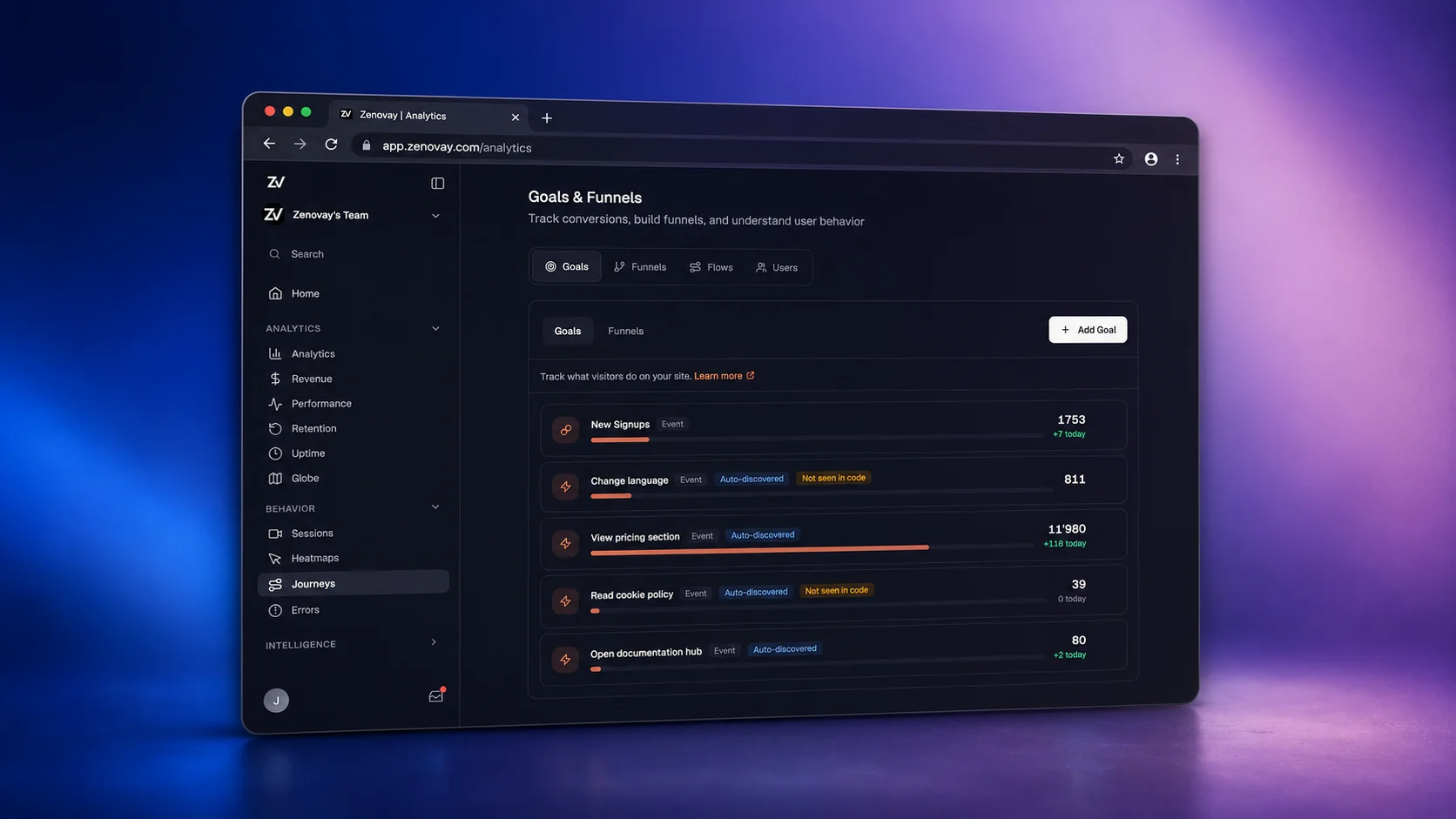
With your journey mapped, set up tracking for each funnel step. Zenovay captures page views automatically, and you can define custom events for specific actions like button clicks, form submissions, or feature usage.
- Be specific about what constitutes a conversion
- Consider micro-conversions that lead to the main goal
- Document the expected path users take to reach this goal
- Use descriptive names that make reports easy to understand
- Track both the action and relevant properties (e.g., product category, plan type)
- Test your tracking to ensure events fire correctly before analyzing data
Analyzing Drop-Off Points
The real value of funnel analysis comes from understanding where and why users leave. Drop-off analysis reveals the friction points in your user experience that prevent conversions.
Reading Your Funnel Report
When viewing your funnel in Zenovay, you will see the number of users at each step and the percentage who progress to the next stage. Focus on steps with the largest drop-offs as these represent your biggest opportunities for improvement.
Key Metrics to Watch:
Common Drop-Off Causes
Understanding why users leave helps you prioritize fixes. Here are the most common reasons for funnel drop-offs:
- 01 Step conversion rate: Percentage moving from one step to the next
- 02 Overall conversion rate: Users completing the entire funnel
- 03 Time between steps: How long users spend at each stage
- 04 Exit pages: Where users go when they leave the funnel
- Confusing navigation: Users cannot find what they need or the next step is unclear
- Too many steps: The path to conversion is longer than necessary
- Unexpected costs: Shipping fees or hidden charges appear late in checkout
- Trust concerns: Users are not confident about security or legitimacy
- Technical issues: Slow loading, errors, or mobile compatibility problems
- Friction in forms: Too many fields or unclear requirements
Optimization Strategies
Once you have identified problem areas, it is time to optimize. Effective funnel optimization is an iterative process of hypothesizing, testing, and measuring results.
Prioritize High-Impact Changes
Not all drop-offs are equal. Use this framework to prioritize your optimization efforts:
High Priority
Lower Priority
Proven Optimization Tactics
Apply these strategies based on where drop-offs occur in your funnel:
“The goal of funnel optimization is not just to increase conversions, but to create a smoother, more enjoyable experience for your users.”
Running A/B Tests
Before implementing changes site-wide, validate your hypotheses with A/B tests. This ensures your optimizations actually improve conversion rates rather than causing unintended consequences.
- Steps with drop-off rates above 50%
- Early funnel stages (affects all downstream)
- Issues affecting high-value visitor segments
- Quick fixes with clear solutions
- Steps with small absolute numbers
- Drop-offs that may be intentional (browsing)
- Issues requiring major infrastructure changes
- Low-traffic pages or segments
- Simplify forms: Remove unnecessary fields, use smart defaults, and add inline validation
- Add progress indicators: Show users where they are in multi-step processes
- Build trust signals: Display security badges, testimonials, and guarantees
- Optimize page speed: Every second of delay reduces conversions
- Clarify calls-to-action: Make the next step obvious and compelling
- Reduce decision fatigue: Limit choices and highlight recommended options
- Form a clear hypothesis about what will improve and why
- Test one change at a time for clear attribution
- Run tests until you reach statistical significance
- Monitor the entire funnel, not just the step you changed
- Document results and learnings for future reference
Measuring Success
Effective funnel optimization requires ongoing measurement. Set up dashboards and alerts to track your progress and catch regressions early.
Key Performance Indicators
Track these metrics to gauge the health and improvement of your funnels:
Setting Up Alerts
Configure alerts in Zenovay to notify you when conversion rates change significantly. This helps you catch issues quickly and celebrate wins in real time.
- Funnel conversion rate: Your north star metric for overall performance
- Step-by-step conversion rates: Identify which optimizations are working
- Time to convert: How long the average journey takes
- Conversion rate by segment: Compare performance across traffic sources, devices, and user types
- Revenue per visitor: Connect funnel performance to business outcomes
- Set threshold alerts for significant drop-off increases
- Monitor goal completion rates daily or weekly
- Track segment-specific changes that might indicate problems
Best Practices Checklist
Use this checklist to ensure your funnel analysis is set up for success:
- Define clear, measurable conversion goals
- Keep funnels focused with 3-7 essential steps
- Test event tracking before analyzing data
- Segment your analysis to find meaningful patterns
- Prioritize optimizations by impact and effort
- Run A/B tests before rolling out changes
- Set up monitoring and alerts for ongoing tracking
- Review and iterate on your funnels regularly
Next Steps
Conversion funnel analysis is one of the most powerful tools for growing your business. Start with your most important user journey, set up tracking, and begin the cycle of analysis and optimization.
Remember that funnel optimization is an ongoing process, not a one-time project. User behavior evolves, your product changes, and there are always new opportunities to improve. Build funnel analysis into your regular workflow to continuously drive better results.
Related Articles
Web Analytics Best Practices for 2026
Understanding Visitor Scoring: Identify Your Best Leads